A unique institution that has been actively supporting research and creative practices since 1928, Casa de Velázquez is a French institution located in the heart of Madrid's university district.
At the intersection of disciplines, it focuses its activities on residency programs, production support mechanisms, and a wide range of internal and external programming. It carries out this work under the supervision of the ministère chargé de l'Enseignement supérieur et de la recherche.
Research in the humanities and social sciences is supported by the École des hautes études hispaniques et ibériques (EHEHI), the scientific section of Casa de Velázquez. A fully-fledged international research center, it also offers a wide range of support services for researchers at all stages of their careers. Its actions and programming are focused on the Iberian Peninsula, the Maghreb and Latin America.
Casa de Velázquez's support for the creative arts is expressed through its artistic section: the Académie de France Madrid. A multi-disciplinary residency, it supports artists in the development of their projects through programs allowing stays of up to eleven months. As a production and distribution platform, it plays an essential role in the development of cultural and artistic exchanges on an international scale.
Specializing in the Iberian cultural area, the library houses over 160,000 volumes, 1,800 periodical collections and a reserve of some 3,800 rare and precious works.
This spectacular collection, with direct access, covers many fields, including the history of Spain, Portugal and Latin America, the social sciences, peninsular and Maghreb archaeology, the arts and Spanish literature.
The Editorial Department publishes around ten scientific works a year, in print and digital format, as well as a biannual journal, Mélanges de la Casa de Velázquez. Its four collections (Bibliothèque, Collection, Essais, Sources) cover research in the humanities and social sciences in a wide range of geographical areas and specialties, with no period restrictions. Reflecting the hybridity of the institution, the Artis Amore collection, created in 2023, offers works based on the dialogue between research and creation, in a variety of formats.
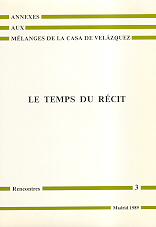
Le temps du récit
Contribution à une modélisation de l'événement en fonction du temps dans le récit historique médiéval
Georges Martin Contribution à une modélisation de l'événement en fonction du temps dans le récit historique médiéval
Temps des mots, temps des pierres : Sagonte et le récit antique
Agnès Pelletier Temps des mots, temps des pierres : Sagonte et le récit antique
L'unité de temps dans le théâtre
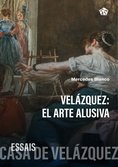
Mercedes Blanco L'unité de temps dans le théâtre
Tiempos del teatro y tiempo en el teatro
José Luis García Barrientos Tiempos del teatro y tiempo en el teatro
L'effet de temps ou la construction temporelle du Quichotte
Nadine Ly L'effet de temps ou la construction temporelle du Quichotte
Utopie et uchronie : sur la première phrase du Don Quichotte
Maurice Molho Utopie et uchronie : sur la première phrase du Don Quichotte
El orden temporal en las primeras novelas de M. Vargas Llosa
Alfonso Sánchez Rey El orden temporal en las primeras novelas de M. Vargas Llosa
Juan Rulfo. Le temps déserté
Milagros Ezquerro Juan Rulfo. Le temps déserté
Répétition et variation dans un roman de Juan García Hortelano: Los vaqueros en el pozo
Geneviève Champeau Répétition et variation dans un roman de Juan García Hortelano: Los vaqueros en el pozo
La unidad de tiempo en la novela
Darío Villanueva La unidad de tiempo en la novela
Racontant et raconté : les deux temps du récit
Claude Bremond Racontant et raconté : les deux temps du récit
Subjetividad y temporalidad en el relato
Cristina Peña Marín Subjetividad y temporalidad en el relato
Tiempo del relato y representación subjetiva (Un problema teórico y unos cuentos de J. Cortázar)
José María Pozuelo Yvancos Tiempo del relato y representación subjetiva (Un problema teórico y unos cuentos de J. Cortázar)
Temps de l'homme et temps de Dieu : le temps du récit autobiographique dans les Confessions de saint Augustin
Jacques Fontaine Temps de l'homme et temps de Dieu : le temps du récit autobiographique dans les Confessions de saint Augustin
Epílogo (A modo de síntesis)
Maurice Molho , Nadine Ly Epílogo (A modo de síntesis)
Paperback
Available
Share