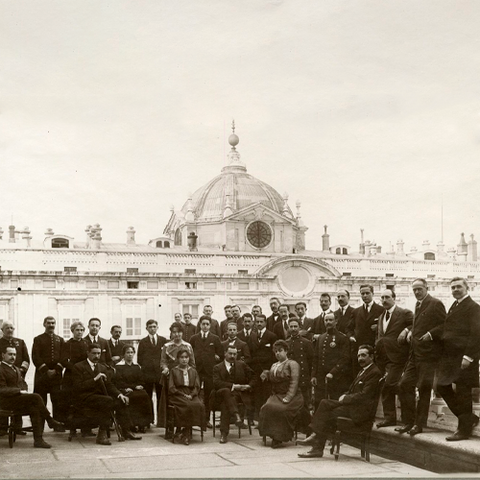
Coord.: Zorann Petrovici (Universidad Pontificia Comillas / Universidad Nebrija), Nina Régis (Casa de Velázquez)
Calendar:
Deadline for applications: 1 December 2025
Notification: 15 December 2025
Conference dates: 15-17 April 2026
Presentation and topics
The First World War, known to contemporaries as the Great War, was one of the twentieth century’s most traumatic events for soldiers (Audoin-Rouzeau, 2001), couples (Vidal-Naquet, 2014) and children (Pignot, 2012). Nevertheless, this war also marked a decisive turning point in the definition of humanitarianism, humanitarian practices and international law (Wylie/Landsfeld, 2022). In this context, neutral countries such as Spain, Denmark, the Netherlands, Switzerland and Sweden acted as protecting powers (Delaunay, 2010; Wyler, 2010) and played a key role, as did organizations such as the national Red Cross societies, the International Committee of the Red Cross (ICRC), and the Young Men’s Christian Association (YMCA).
Research has focused particularly on the ICRC (Tate, 2017), the Swiss case (Yerly, 1998; Cotter 2018) and the treatment of POWs (Hinz, 2006; Jones, 2011; Farré, 2014; Stibbe, 2019; Theofilakis, 2022; Bauerkämper et al., 2025). Humanitarianism (Becker, 2003; Cabanes, 2003; Gatrell et al., 2017; Piller/Wylie, 2023) and neutrality (Hertog/Kruizinga, 2011; Clavien/Hauser, 2014; Marcilhacy, 2018) have been extensively studied, as Spanish neutrality (Delaunay, 2014; Montero, 2015; Pons 2015). In the last ten years, the Spanish case has been examined (Fuentes, 2017; Pires 2020), including the role of the monarchy (Alonso/Mairal, 2018; Sanz/Petrovici, 2019). Recent and very innovative studies show that this field is now flourishing (Pérez de Arcos, 2021/2024; Petrovici, 2025). However, the actions of neutral states, humanitarian institutions and the everyday experience of humanitarianism have rarely been compared or analyzed in an interconnected way. This was due to the language barrier and the difficulty of cross-referencing several national historiographies. Moreover, much remains to be done to shed light on the various ways in which neutral nations provided aid. What is lacking above all are studies of Spanish action in a global and transnational context, hence the focus of this conference.
Building on the dynamic initiated during a workshop held in 2024 on the humanitarian institution created in 1915 by Alfonso XIII–the European War Office–, this conference seeks to gather separate initiatives and to bring together specialists to address historiographical gaps concerning Spanish actions during the war. As few studies go beyond 1918 (Hermann, 2012; Kowner/Rachamimov, 2022), the conference will examine these actions from a global perspective in the context of the 1920s by comparing them with the actions of other institutions and neutral countries, such as Sweden, Denmark, the Vatican and the ICRC.
This initiative is based on the conviction that this approach will produce more inspiring, relevant and compelling research for understanding the connections between institutions across multiple countries and sources written in multiple languages. This is especially promising given the immensely rich archives produced by the Spanish monarchy during the war, which have recently been included by the UNESCO in its «Memory of the World» Programme. The conference will also provide an opportunity to broaden the disciplinary, geographical and temporal scope of First World War Studies, as proposed by John Horne and Robert Gerwarth. The aim is to develop an integrative perspective on humanitarian action and ‘transnational neutrality’, examining the humanitarian challenges faced by neutral countries and institutions that were literally caught in the crossfire on different fronts.
What interests and objectives guided the actions of humanitarian actors, organizations and institutions? Where did the financing for those actions come from? To what extent are they engaged, or trying to engage, while remaining neutral, and why? What roles did mediators and facilitators play in the circulation of information? Participants are invited to focus on these actors, their discourses, and the role of information exchange as a lever for their humanitarian efforts.
The topics covered will fall within the following research focus:
Neutral countries and humanitarian institutions
- Humanitarian organisations, welfare monarchies and humanitarian actions financing
- Comparison between humanitarian institutions
- Humanitarian law, neutrality, and the legal defence of prisoners of war
- Power, discourses, propaganda and public opinion
The everyday experience of humanitarian action
- The materiality of humanitarian work (material culture, including medical care, money, clothing, literature and books, food and hunger, theatre, sports, cinema…)
- Experience of delegates visiting prison camps, experiences of prisoners, of civilians (women, children and the elderly) and their reception of humanitarian aid
- Petitioner practice: writing letters to kings, politicians and institutions to find relatives and assist POWs
Humanitarian actions and international relations
- Diplomatic issues related to humanitarianism and neutrality
- Neutrality and ‘transnational humanitarianism’
- Prosopographical studies of humanitarian actors from neutral countries
Humanitarianism and neutral states after the war: actions and memory
- Actions and the role of the League of Nations
- Refugees and individual initiatives, such as those of Fridtjof Nansen
- Questions of memory (historiographical approaches and musealization)
Conditions of application and practical considerations:
The deadline for applications is 1 December 2025. Interested candidates should submit the title and a 300-word summary of their intended contribution, along with a brief academic CV.
Please send your application to both of the following email addresses: zpetrovici@comillas.edu and nina.regis@casadevelazquez.org
Conference languages: English, Spanish, French. In order to contribute to the international character of the conference, we strongly encourage English contributions. For those submitted in French or Spanish, a detailed abstract in English will be required.
Bursaries: For early career researchers, postgraduate students and precariously employed participants, accommodation will be provided. Travel expenses will be partially covered thanks to a travel grant within the limits of available funding. Financial support will also be available for ECRs who need to translate the detailed abstracts used at the event.
Scientific Committee
Stéphane Audoin-Rouzeau
EHESS, ParisArnd Bauerkämper
Freie Universität, BerlinAnnette Becker
Université Paris-NanterreCédric Cotter
ICRC, GenevaSebastien Farré
Université de GenèveIrene Hermann
Université de GenèveDavid Marcilhacy
Sorbonne UniversitéJosé Antonio Montero Jiménez
Universidad Complutense de MadridAntonio Manuel Moral Roncal
Universidad de Alcalá de Henares
Organising Committee
Alejandro Acosta López
Universidad Carlos III de MadridBerta Lillo Gutiérrez
Universidad de AlicanteDavid Miguel Vidales
Universidad de Valladolid- Nicolas Stassar
Freie Universität, Berlin
- Beatriz Valverde Contreras
Universidade de Coimbra